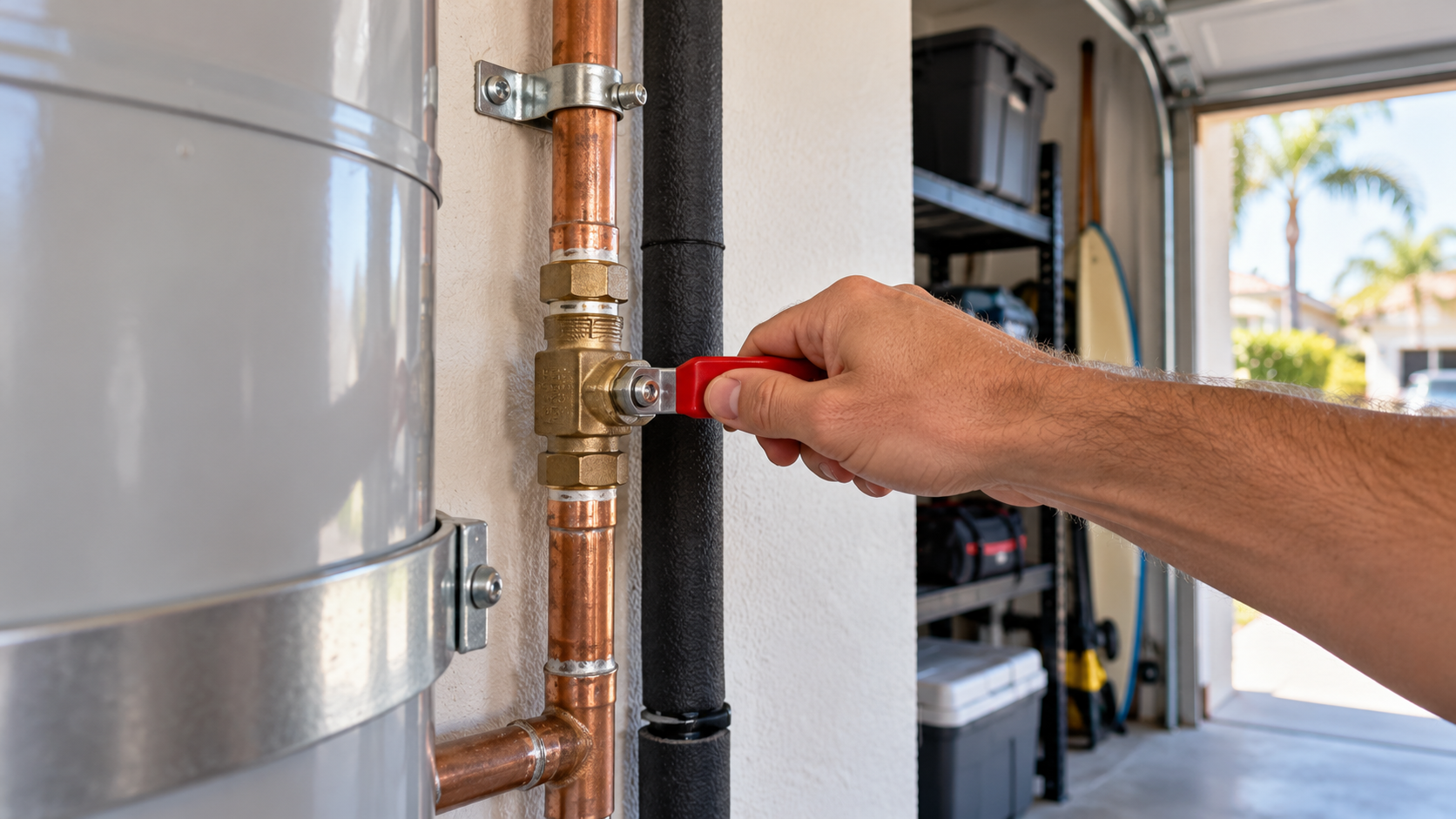
When a pipe bursts or a supply line under the sink lets go, the first thing that matters is how fast you can stop the water. Every minute it keeps running means more damage to floors, walls, and cabinets. That's why knowing where your main water shut off valve is, and how to use it, is worth figuring out now, before there's water on the floor.
For California homeowners there's another reason. The San Francisco Public Utilities Commission points out that during an earthquake, water heaters and appliances connected to your plumbing can shift and cause leaks. Knowing how to shut off water to your house is a basic part of being prepared, whether you live in San Diego or anywhere in North County.
Where Is the Main Water Shut Off Valve?
Where the valve sits depends largely on how your home was built. It's usually larger than the other valves in your home and has either a lever or a round, wheel-like handle.
Near the Water Heater in Slab Homes
If your home is built on a concrete slab, start by looking at the water heater. According to Angi, in slab homes the main shut off valve is typically near the water heater tank, either under it or at the top. If your water heater is in the garage, start there. For homes with a crawl space, Angi notes the valve is usually along the front wall of the house.
Outside the House, in Line With the Meter
If you don't find it inside, look outside. The SFPUC notes that most main shut off valves are located on the exterior of the home, or just inside the property in line with the water meter. Since the meter is usually at the front of the property, check the side of the house closest to it. The SFPUC also notes that the valve is sometimes painted red, which makes it easier to spot. In older homes, Angi says the valve may be inside a valve box or access point near the front of the property.
Your Water Meter Is Not Your Shutoff
It's easy to confuse the main valve with the water meter, but they're different things. According to the City of San Diego, the water meter is usually located near the curb in front of your home, inside a concrete box. The City also notes that the property owner is responsible for the water system from the meter onward. The meter marks where the utility's system ends and yours begins, and the valve you want to know is the one on your side of it.
How to Shut Off Water to Your House
Once you've found the valve, turning it off depends on which type you have. Most homes have one of two kinds.
Ball Valves
A ball valve has a straight lever handle. To close it, turn the lever a quarter turn, 90 degrees, so it sits perpendicular to the pipe. When the lever runs in the same direction as the pipe, the water is on. When it crosses the pipe, the water is off. Ball valves are quick and easy to operate, which is a big advantage in an emergency.
Gate Valves
A gate valve has a round handle, similar to an outdoor hose spigot. To close it, turn the handle clockwise until it stops. The SFPUC describes gate valves as designed to shut off and turn on slowly, so give it time rather than rushing it.
Either way, once the valve is closed, open a faucet in the house to confirm the water has stopped.
What to Do If the Valve Won't Turn
Valves that haven't been touched in years can be stiff, especially older gate valves. It's tempting to grab a wrench and force it, but Angi warns against forcing a gate valve, since too much pressure can damage the handle or the valve itself. A broken valve during an emergency leaves you with no way to stop the water.
If the valve won't close, or if it starts leaking when you turn it, stop and call for help. Angi recommends contacting a licensed plumber or your water utility's emergency line if you can't get the valve closed. If water is actively flowing and you can't shut it off, that's a situation for emergency plumbing services.
A stiff or leaking valve is also worth dealing with before there's an emergency. It's much easier to have a valve repaired or replaced on your schedule than in the middle of a burst pipe.
Checking for Hidden Leaks With Your Meter
Your water meter can also help you catch a leak you can't see. The City of San Diego describes a simple check. Turn off every faucet and water-using appliance in the house, then look at the meter. If it's still turning, chances are you have a leak somewhere. The City also advises removing the meter box lid with a tool rather than your fingers.
If the meter shows water moving with everything off, the leak could be in a supply line, under the slab, or somewhere else out of sight, and professional leak detection can track down where it's coming from.
For homeowners who want protection even when no one is home, an automatic shut off device can close the water supply on its own when it detects a leak. Our post on Moen Flo smart water shut off valves explains how they work. Either way, the best time to find your main water shut off valve is today, while everything is dry.